"When Are You Having Kids?": How to Set Boundaries with Nosy Relatives
You are at a sunny family reunion, catching up with a cousin you haven't seen in years, when a loud voice cuts through the conversation. Your aunt leans in and asks, "So, when are you and your partner going to start having kids?" Suddenly, the air feels heavy, and the eyes of several nearby relatives turn toward you, waiting for an answer to a deeply private question. I refer to this common, high-pressure experience as the Inquisition Trap. It is that jarring moment when a relative’s curiosity overrides your right to privacy, leaving you feeling exposed and obligated to explain your life choices to a crowd. This article will show you how to navigate these intrusive moments by reclaiming your right to say as much or as little as you choose, allowing you to participate in family events without the fear of being interrogated.
Why the Family Reunion Feels Like an Interrogation
The discomfort you feel in these moments is not a sign that you are being "too sensitive." It is a natural response to a violation of your personal boundaries. At a deep, biological level, we are wired for tribal belonging, which often makes the prospect of setting a boundary feel like a threat to our safety within the family unit. To understand this tension, we can look at Stephen Karpman’s Drama Triangle, a concept within Transactional Analysis. When a relative asks an intrusive question, they are often unconsciously inviting you into a "Victim" or "Prosecutor" role. If you feel forced to explain yourself, you have entered the triangle as a Victim. If you snap back in anger, you have entered as a Prosecutor. Chronic participation in this cycle leads to emotional burnout and a growing sense of resentment toward the people you are supposed to enjoy being around.
Understanding the Internal Scripts of Family Dynamics
To understand why a simple question about children can feel like an emotional ambush, we must look at the "ego states" we use when we communicate. In Transactional Analysis, a theory developed by Eric Berne, every person operates from three distinct states of being: the Parent, the Adult, and the Child. When you are at a family reunion, these roles often become rigid. A nosy relative frequently speaks from a "Critical Parent" ego state. This state is not necessarily about being a mother or father: it is a psychological position characterized by judging, monitoring, or "knowing what is best" for others. When your aunt asks about your timeline for children, she is often unconsciously speaking from this position of authority, which naturally invites you to respond from a "Child" ego state.
The Pull of the Adaptive Child
When you are addressed from a relative’s "Parent" state, your psyche is pulled toward the "Adaptive Child" state. This is the part of us that learned, long ago, how to survive and belong within our family tribe by being compliant, polite, or apologetic. In this state, you might feel a physical "fawn" response. Your heart rate might increase, your voice might go up in pitch, and you may feel an overwhelming urge to give an answer just to lower the tension in the room. It is a learned behavior designed to maintain peace, but it comes at the high cost of your own autonomy. This dynamic is why you might find yourself over-explaining your medical history or your financial plans to a relative you barely see. You aren't just answering a question: you are reacting to an old, ingrained script that says your privacy is less important than the relative's comfort.
Breaking the Cycle with the Adult State
The way out of this "Parent-Child" trap is to intentionally shift into the Adult ego state. Unlike the Parent state, which is rooted in the past (rules and judgments), or the Child state, which is rooted in emotional memory (compliance and rebellion), the Adult state is rooted in the present. It is the part of your personality that processes data, remains objective, and sets boundaries based on current reality rather than old family scripts. When you respond from your Adult state, you are no longer a child needing to "explain yourself" to an authority figure. You are one adult speaking to another. This shift is what allows you to hear an intrusive question and realize that while the relative has the right to ask, you have an equal right to decline the answer. By staying in the Adult state, you essentially refuse to play the role that the family script has assigned to you.
The Mechanics of the Family "Drama Triangle"
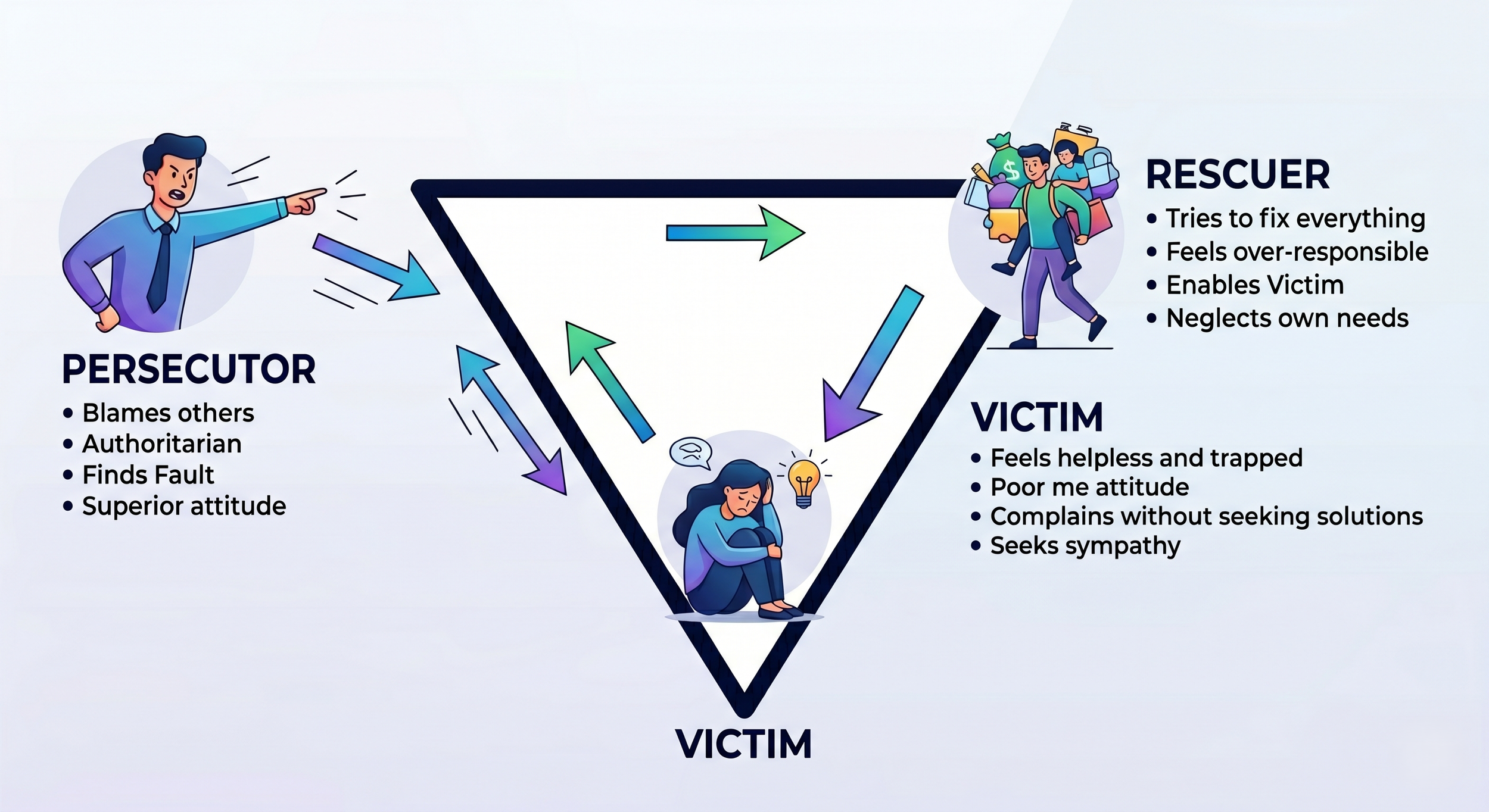
Karpman’s Drama Triangle
While ego states explain who is talking, the Drama Triangle, a social model developed by Stephen Karpman, explains the "game" being played. In these high-stakes family gatherings, interactions often devolve into a predictable three-sided conflict involving the Persecutor, the Rescuer, and the Victim. When a relative corners you about your personal life, they are often stepping into the Persecutor role, even if their tone is sugary-sweet. They are exerting pressure to get you to conform to their expectations. If you respond by over-explaining or looking distressed, you have accepted the role of the Victim.
Identifying the Move to the "Victim" Role
The "Victim" position in this triangle is not about actual helplessness: it is about a psychological stance where you feel you have no choice but to comply with the interrogation. You might think to yourself, "I have to answer or they’ll think I’m being rude," or "If I don't tell them something, the whole dinner will be ruined." This is the internal dialogue of the Victim role. By feeling forced to provide personal data, you unintentionally validate the relative's perceived right to ask. It is a state where the family’s collective history and expectations act as a cage, making the simple act of staying silent or changing the subject feel like a radical act of rebellion rather than a healthy boundary.
Resisting the Urge to Become the "Prosecutor"
On the other side of the triangle is the Prosecutor. This happens when the pressure of the interrogation becomes too much and you "snap." You might respond with a biting comment like, "Why don't you worry about your own life?" or "I'll have kids when you stop being so nosy." While this might feel satisfying for a split second, it keeps you trapped in the triangle. By attacking back, you provide the relative with evidence that you are the one being difficult or "sensitive," allowing them to flip the script and play the Victim themselves. To truly set a boundary, you must refuse to enter the triangle at all. You do this by remaining in the Adult state we discussed earlier, providing a response that is neutral, firm, and entirely devoid of the emotional hooks that fuel the Drama Triangle.
The Social Cost of Breaking the Script
It is important to acknowledge that the pressure to stay within the Drama Triangle is not just in your head: it is a social force. When you refuse to play the Victim or the Prosecutor, you are essentially breaking the script of the family system. This can create a temporary moment of social friction because the other person, the relative asking the questions, now has to find a new way to relate to you. They may even double down on their efforts to pull you back into the old dynamic by using guilt, such as saying, "I’m just asking because I’m excited for you," or "You used to be so open with us." Recognizing this as a predictable response to a change in the family dance can help you stay grounded. You are not being cold or difficult. You are simply choosing to interact as an Adult, which is the healthiest position for any long-term relationship.
Mastery of the "Broken Record": Your Tool for Privacy
Setting a boundary is a skill, much like learning a new language or a physical exercise. It requires moving from an internal feeling of discomfort to an external expression of your limits. In the world of Assertiveness Training, popularized by researchers like Manuel J. Smith, one of the most effective tools for maintaining your Adult state in the face of persistence is a technique known as the "Broken Record."
The Broken Record technique is exactly what it sounds like: the calm, persistent repetition of a concise, neutral statement that communicates your boundary without offering excuses or further explanation. Its power lies in its simplicity. When you provide a long-winded explanation for why you aren't ready for kids, or why you don't want to talk about your career, you are essentially giving the nosy relative ammunition to argue with you. If you say, "We aren't having kids because we want to travel more," the relative can counter with, "You can travel with a baby!" However, when you use a Broken Record statement, there is nothing for the other person to hook onto. You are providing a clear limit rather than an opening for a debate.
Implementing the Broken Record at the Family Reunion
To use this tool effectively, you first need to identify your "Adult statement." This is a short, neutral sentence that acknowledges the relative’s question without engaging with the content. For the "when are you having kids" interrogation, your statement might be: "I know you’re curious, but that isn't something I’m discussing today." Or, a simpler version: "That is a private matter, but I appreciate your interest." The key is to choose a phrase that feels natural to you and remains entirely focused on your boundary rather than their curiosity.
The Power of Neutral Repetition
Once you have your statement, the "Broken Record" technique involves repeating it exactly as written every time the relative pushes back. At a family reunion, the relative will likely try to "hook" you back into the Drama Triangle with a follow-up.
Relative: "Oh, come on! I’m your aunt, you can tell me. Is it a health thing?"
You (Adult State): "I understand you’re curious, but as I said, that isn't something I’m discussing today."
By using the exact same phrasing, you signal that there is no room for negotiation. You are not being aggressive: you are simply refusing to provide a different answer. This lack of variation is what makes the technique so effective. It prevents the conversation from escalating into an argument because you are not giving the relative any new information to attack or question.
Maintaining Your Composure
The most difficult part of using this technique is managing your internal "Adaptive Child." While your words are staying in the Adult state, your body might still feel the urge to apologize or "soften" the blow. You might feel the need to say, "I’m sorry, but..." or "I hope you don't mind, but...". In Assertiveness Training, we learn that these qualifiers actually weaken your boundary. They signal to the relative that you feel guilty for having a limit, which invites them to keep pushing. To stay grounded, focus on your breathing and keep your tone of voice steady and matter-of-fact. You are simply stating a fact about your current boundaries, much like you would state a fact about the weather.
Defusing Tension with the "Fogging" Technique
While the Broken Record is perfect for persistence, sometimes a relative uses a more subtle, critical edge. They might say, "You know, you aren't getting any younger," or "I just don't want you to have regrets later in life." These comments are designed to provoke a defensive reaction, pulling you straight back into the Child state. In these moments, you can use a technique called Fogging.
Fogging involves finding a small piece of truth in what the relative is saying and agreeing with that specific part, while remaining completely neutral about the rest. By doing this, you offer no resistance. Much like throwing a stone into a thick fog, the relative's criticism finds nowhere to land. It is a powerful way to stay in your Adult state because it requires you to listen objectively rather than emotionally.
How to Use Fogging Without Giving In
The secret to effective Fogging is the word "agree." You are not agreeing with their underlying judgment, only with the factual possibility of their statement.
Relative: "If you wait too long to have kids, you might really regret it."
You (Adult State): "You’re right, that is certainly a possibility."
Relative: "And it gets much harder to keep up with them when you're older!"
You (Adult State): "I agree, energy levels definitely change as we age."
By agreeing with these general truths, you have effectively ended the "game" of the Drama Triangle. You are not being a Victim by defending your choices, and you are not being a Prosecutor by attacking their unsolicited advice. You have simply acknowledged a fact and left no room for further debate. This technique is particularly useful at family reunions because it allows you to remain polite and "agreeable" on the surface while keeping your internal boundaries completely intact.
Moving Beyond the Critical Hook
It can feel counterintuitive to agree with someone who is being intrusive. Your initial instinct might be to argue your side or explain why their logic is flawed. However, remember that in the context of a nosy relative, an argument is exactly what they are looking for: it is an invitation to stay connected through conflict. Fogging creates a "boring" response. When you stop providing the emotional reaction they expect, they will eventually move on to a different topic or a different person. This is not about winning the argument: it is about protecting your peace and maintaining the dignity of your Adult state.
Transitioning with the "Pivot"
Once you have successfully used the Broken Record or Fogging to hold your ground, the final step is to lead the conversation away from the interrogation and back toward connection. This is the Pivot. A common mistake in boundary setting is to stop talking immediately after setting the limit, which can create a heavy, awkward silence that makes the "Adaptive Child" within you feel panicked. By using a Pivot, you demonstrate that while the personal topic is off-limits, you are still present and willing to engage in a healthy, Adult-to-Adult conversation. This technique reinforces that your boundary is not a wall intended to shut the other person out, but a gate that controls what information is allowed to pass through.
How to Execute a Graceful Pivot
The Pivot should be immediate and focused on a neutral or positive subject that shifts the spotlight away from you. Ideally, you want to ask the relative a question about their own life, as most people who ask intrusive questions are also quite happy to talk about themselves.
Relative: "But don't you think you're being a little selfish by waiting?"
You (Adult State/Fogging): "I can see why it might look that way from your perspective. (Pivot) By the way, I heard you recently started that community garden project. How is the harvest coming along this year?"
In this example, you have acknowledged their statement without defending yourself, and you have immediately moved the "ball" back into their court. This redirection is essential at a family reunion because it allows the social flow to continue without you having to sacrifice your privacy. It also signals to the relative that the "Inquisition Trap" is closed for business, and the only way to continue interacting with you is through more appropriate, mutual topics.
Handling Persistence After the Pivot
There may be times when a particularly determined relative refuses to take the Pivot and tries to circle back to their original question. They might say, "The garden is fine, but we were talking about your future!" In this case, you simply return to your Broken Record statement. You might say, "The garden sounds lovely, but as I mentioned, my personal timeline isn't something I’m discussing today." If they still persist, it is perfectly acceptable to use a physical pivot: "I’m going to go grab some more lemonade, but it was good catching up for a bit." Remember, an Adult-to-Adult interaction requires two willing participants. If they refuse to respect your Adult state, you are not obligated to stay and remain a "Victim" to their interrogation.
The Conflict of Intent vs. Impact
One of the greatest hurdles in setting boundaries at a family reunion is the internal guilt that arises when you believe a relative has good intentions. You might think, "Aunt Sarah just wants me to be happy," or "They aren't trying to be mean, they’re just excited." In clinical terms, this is a conflict between Intent and Impact. While your relative’s intent may indeed be rooted in love or tradition, the impact of their question is a violation of your privacy and a source of significant stress. It is vital to recognize that having good intentions does not grant someone a "free pass" to bypass your boundaries. You can acknowledge their kindness while still protecting your space. Setting a limit is not a punishment for their curiosity: it is a necessary act of self-preservation that allows you to continue the relationship without the weight of resentment.
Navigating the "Well-Meaning" Guilt Trip
When you stay in your Adult state, you are better equipped to handle the subtle guilt trips that often follow a boundary. A relative might say, "I only ask because I care about you," which is a classic move to pull you back into the Victim role of the Drama Triangle. From an Adult perspective, you can see this for what it is: an attempt to make their comfort your responsibility. A grounded response acknowledges their care without retracting your boundary. For example, you might say: "I appreciate that you care about me, and I’m glad we can talk about other things today." By refusing to apologize for your limit, you teach your family how to treat you in this new, differentiated way. You are effectively communicating that your relationship is based on mutual respect rather than forced transparency.
Reclaiming Your Narrative
As you practice these tools, you will begin to notice a shift in your internal narrative. You are moving from being a subject of inquiry to an agent of choice. The goal of using the Broken Record, Fogging, and the Pivot is not to "win" a family reunion or to change your relatives' personalities. Rather, the goal is to maintain your own integrity. When you leave a family event knowing that you protected your private life and stayed out of the Drama Triangle, you build a sense of self-trust that carries over into every other area of your life. You are no longer at the mercy of someone else’s curiosity. You are the one who decides what is shared, when it is shared, and with whom.
What's Next?
Learning to set boundaries with family is a process that takes time, patience, and often a few "clunky" attempts before it feels natural. If you find yourself consistently pulled back into old patterns or feeling overwhelmed by the social cost of breaking family scripts, you are not alone. These dynamics are deeply ingrained and can be difficult to untangle on your own.
For Illinois Residents:
If you are located in Illinois, you can learn more about my practice, Healthy Boundaries and Assertiveness Counseling by booking a free 15-minute consultation at any time. This is a chance for us to see if we're a good fit. Schedule a consultation call today!
For Readers Outside of Illinois:
Licensing laws mean I can only provide therapy to individuals physically located in the state of Illinois. If you're looking for a therapist in your area, here are some general resources you can use:
Online Therapy Directories: Websites like Psychology Today, GoodTherapy, or TherapyDen allow you to search for therapists by location, specialty, and insurance.
Professional Organizations: The American Psychological Association (APA) and American Counseling Association (ACA) websites often have "Find a Psychologist" or "Find a Counselor" tools.
Local Mental Health Associations: Search for mental health organizations in your state or city; they often provide referral services.
Asking for Referrals: Your primary care physician or trusted friends and family members might have recommendations.
